
The Missing Blue
Financing the Ocean,
Imagining a Blue Moral Economy
The Ocean sustains climate stability, biodiversity and economic life, yet the institutions that depend on it continue to finance its decline.
The Missing Blue examines how the Ocean underpins climate action, land restoration and biodiversity protection, while remaining inadequately recognised and financed.

COP31, November 2026BBNJ COP1, January 2027
What is the Missing Blue?
The Missing Blue is the gap between the Ocean’s essential role in sustaining climate, land and biodiversity and the resources and responsibilities our economies devote to its care.
Closing this gap calls for a Blue Moral Economy that reimagines how we finance ocean protection, govern shared waters and support the people and ecosystems that sustain marine life across generations.
- 29%
The Ocean took up an estimated 29% of the carbon dioxide released by human activity, 2015 to 2024. Friedlingstein et al., 2026.
- 91%
The Ocean absorbed around 91% of the excess heat accumulating in Earth’s climate system, 1971 to 2018. IPCC, 2021.
Where the world’s money goes
- US$7.3 trillion to activities that harm nature
- US$220 billion to nature-based solutions
Each disc is US$10 billion. Nature-based solutions protect, manage and restore ecosystems such as forests, wetlands, mangroves and reefs. Figures for 2023, covering land and sea. Source: United Nations Environment Programme.
For the Ocean, marine protection receives about a ninth of what it needs
-
US$1.8 billion a year, of US$15.8 billion needed
Current spending on marine protection leaves an estimated shortfall of US$14 billion every year against the goal of protecting 30% of the Ocean by 2030.
-
3.5% of the Ocean effectively protected
Around 10% of the global Ocean is designated as protected or conserved. Only 3.5% is assessed as effectively protected.
The part-filled disc is drawn to the scale of the chart above, where each disc is US$10 billion. Source: Ocean Protection Gap Report 2026. The spending estimates concern marine protection under the global 30×30 target, not all ocean-related finance.
Where the blue goes missing
Five gaps keep the Ocean’s care out of the budgets that depend on it.
- 1Finance
Money arrives to declare a protected area or plant a meadow, then stops. The daily work of keeping it alive, and the local people who do it, are left without dependable income.


- 2Recognition
Budgets count the coastal road but not the mangroves that shield it from floods. The living systems that make our plans succeed rarely appear in the accounts.


- 3Responsibility
Public money can pay fleets to catch more fish, then pay again to restore the stocks they emptied. The cost of the damage falls on communities and public budgets instead of those who caused it.

- 4Power
Conservation plans are often drawn up far from the shore. People who have cared for these waters for generations can lose access to them and have little say in what protection means.


- 5Imagination
Leaving a reef or the deep seabed undisturbed produces nothing to sell, so finance that must repay investors passes it by. Some of the most important protection is left with no source of funding.



Taken together, the five gaps reveal a problem of economic design. Closing these gaps will require more than additional conservation funding. It means changing the rules that determine which activities are rewarded, whose rights and responsibilities are recognised, and how we support the care of living ecosystems.
The report’s answer is a Blue Moral Economy, an economy whose rules are designed around the care of the Ocean. See what it changesWhat is a Blue Moral Economy?
A Blue Moral Economy organises economic decisions around healthy marine life, human dignity and fair shares across generations.
It treats people who care for the Ocean as workers and decision-makers, and recognises the worth of other species beyond their use to us. It begins from a simple proposition: the economy should serve the needs of people and the living world, with its institutions designed around that purpose.
Today, the Blue Economy encompasses fishing, shipping, tourism, marine energy and other activities connected to oceans and coasts. Yet the growth of ocean industries tells us surprisingly little about the health of marine ecosystems and species, or the wellbeing of the people who depend on them. A Blue Moral Economy also asks who pays for the damage and who is responsible for the care.
The report explores this vision through ten bold economic models that reimagine how we can finance the Ocean’s care and change the rules that drive its decline.
The word moral is where faith communities come in. Faith institutions carry moral authority and hold more than US$7 trillion in assets. They can apply these models to their own endowments and investments, and press governments to change the wider rules.
How faith organisations act on it
Seven principles
Seven principles turn this idea into practice. They address different aspects of how activities are authorised, resources are allocated and institutions are governed.
Nature-positive. Make ecological recovery part of economic success.Funding restoration is not enough while the damage carries on. A nature-positive economy is judged by what improves in the living world, including harm prevented, so a harbour can refuse to expand when the seagrass beneath it cannot take more boats.
Ten models for another Ocean economy
A thriving Ocean requires a stronger moral foundation in ocean economics, and bold economic and institutional possibilities can make this vision practical. These ten models explore how ocean protection could be financed and governed through new arrangements for ecological care, shared responsibility and community authority.
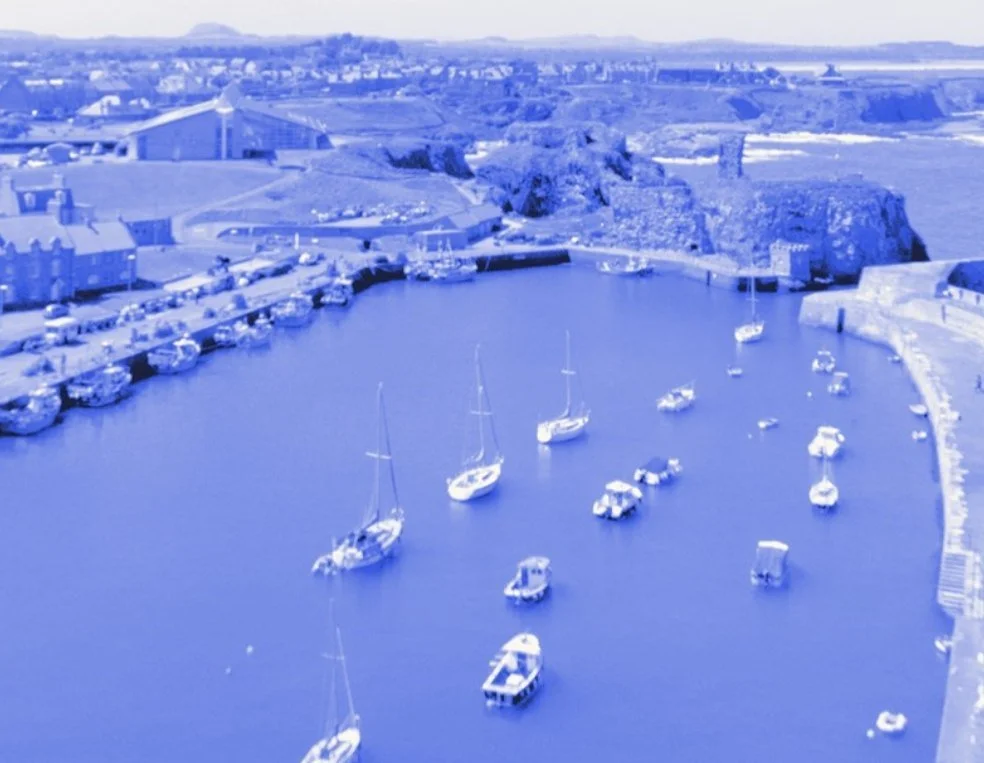
Take a harbour. Its mooring chains scour the seagrass beneath the boats while it goes on collecting its fees, and no one is responsible for the meadow. Each card shows a place like this drained of blue, the way the economy treats it today. Open a model to see the blue come back when the rule changes.
Start with the harbour, Model 11 / 10, swipe for more
Each model is set out in full in the report, with the evidence behind it.
Download the full reportStart with one place and a real budget
Choose one place.
Start with an institution able to act. Agree the living place, pressures, rights-holders and work needed.
Agree rights and authority.
Identify whether the change can use a management plan, licence, trust deed or board rule. If it needs new law or powers, name that route before treating it as operational.
Cost continuing care.
Turn the proposal into a full budget: essential annual care, legal payment duties, confirmed funding, prospective commitments and a route for money to reach workers. Test a weak-revenue year and a major shock. Show who covers the shortfall.
Test and publish results.
Independent review should assess ecological and social results as well as whether money was raised.
Each funder can start within its own mandate.
- Conservation funders can make grants last by tying them to a public or operator duty that carries the work afterwards.
- Development banks can cost the habitats their coastal projects depend on and add debt-pause clauses to disaster planning.
- Foundations can fund first tests that move a public budget.
- Faith institutions can align endowments with conservation purposes and give the Ocean a voice on their boards, as Model 9 proposes.
A shared pilot needs willing partners and agreement on rights.
Faith communities can move the rules and the money towards the Ocean.
Faith groups collectively control more than US$7 trillion in assets. The Faiths High Ambition Coalition for Ocean & Nature Action, coordinated by Faiths for Oceans, helps them turn that weight and their moral commitments into public pledges that can be tracked over time.
Joining means making a public pledge in one area, which the Coalition tracks over time. Pledges cover areas such as sustainable fisheries, marine protection, marine pollution and a moratorium on deep-sea mining, each of which a model in this report puts into practice. The Coalition’s Turning the Tide campaign at the third UN Ocean Conference in June 2025 mobilised more than 300 faith organisations representing over 500 million people.

The institutional change
Choose a step to see it on the photograph. Step 1 shows the place as the economy treats it today.